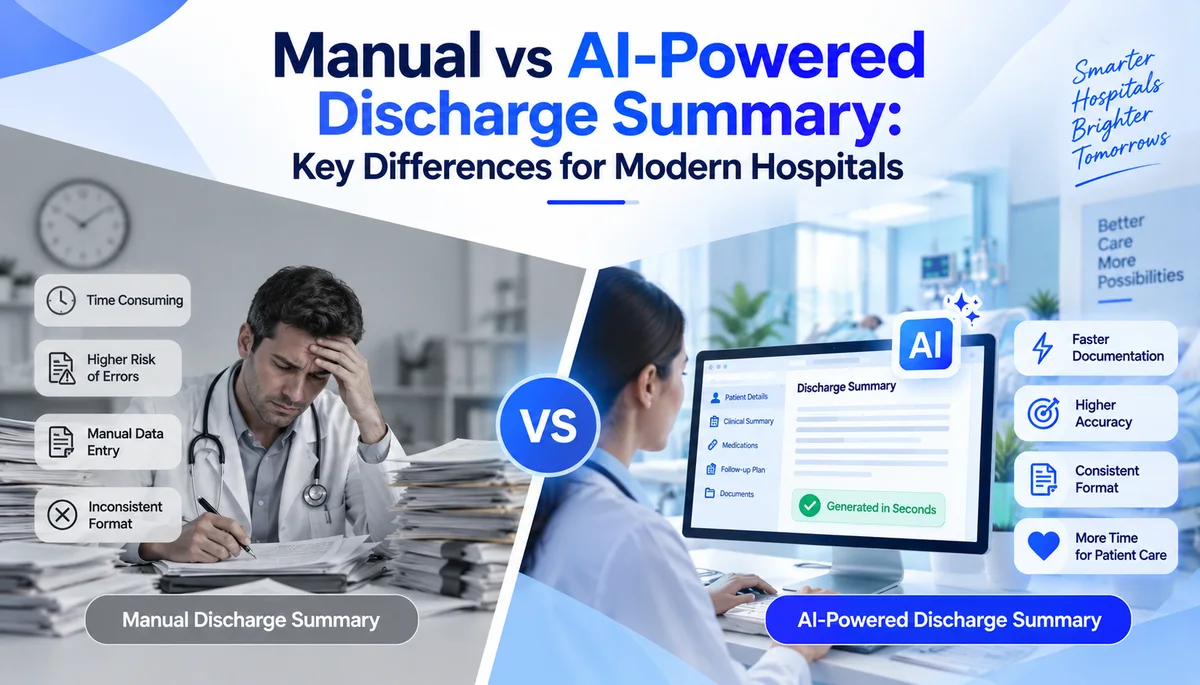
Manual vs AI-Powered Discharge Summary: Key Differences for Modern Hospitals
Discharge documentation has traditionally been a manual task. A doctor reviews the patient's records, collects the relevant information, writes the summary, checks the details, and completes the document before the patient leaves the hospital. That process can work well when patient volumes are manageable. But as hospitals grow and the number of daily discharges increases, the amount of documentation can become difficult to manage. This is where AI medical documentation is gaining attention. Instead of asking healthcare professionals to create every discharge summary from the beginning, AI can assist by organizing information and preparing a draft for review. The difference is not simply between paper. It is a change in how the discharge documentation workflow is handled.
How Manual Discharge Documentation Works
In a traditional workflow, the doctor or assigned staff member usually gathers information from the patient's records.
They may need to review :
- Admission information
- Clinical notes
- Diagnosis
- Investigation reports
- Treatment details
- Procedures
- Medication records
- Follow-up instructions
The relevant information is then entered into the discharge summary. Once written, the document needs to be checked and finalized. When the hospital has a high discharge volume, repeating these steps throughout the day can consume considerable staff time.
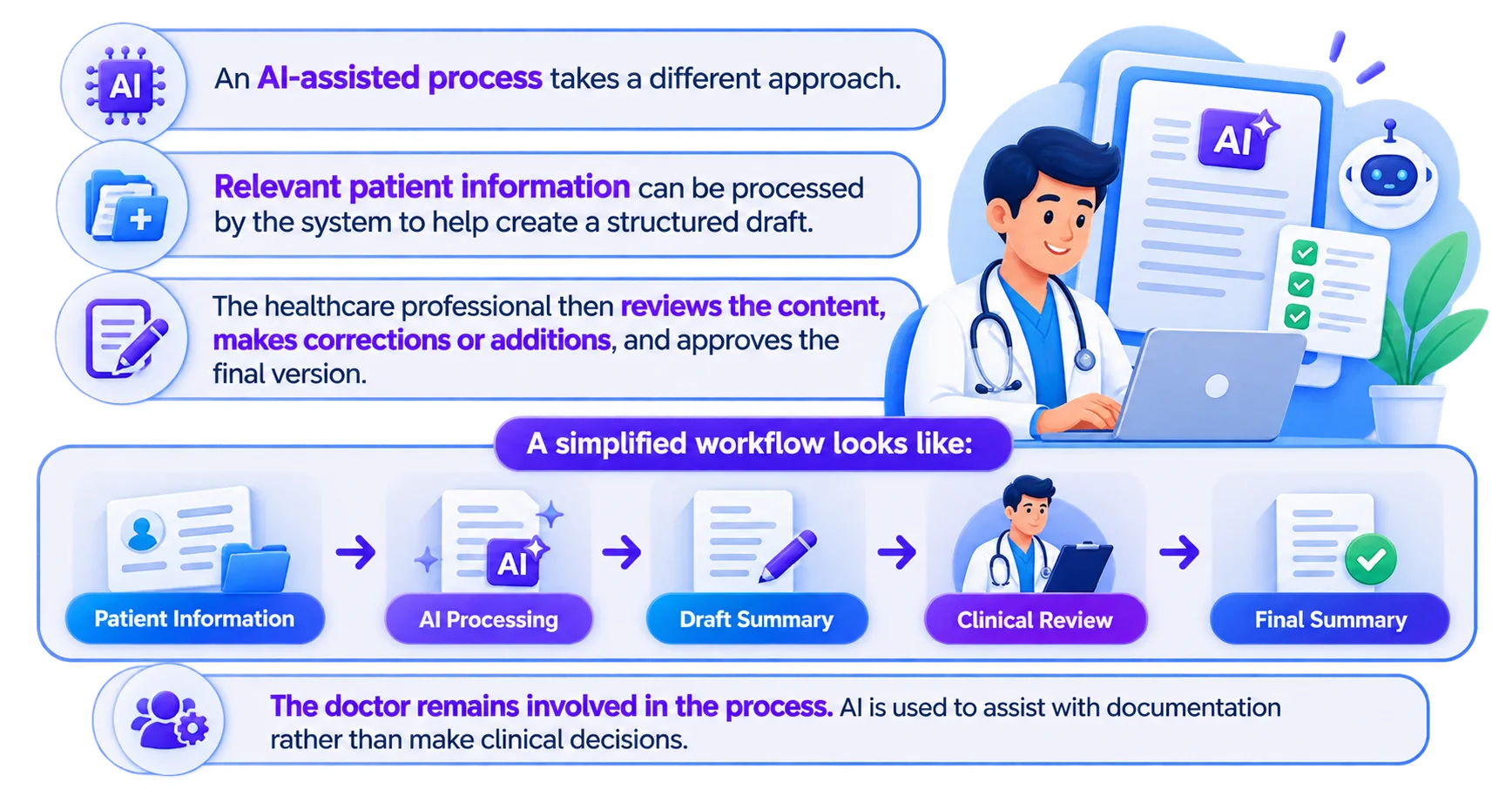
How an AI-Powered Workflow Works
1. Time: Where the Biggest Difference Can Appear
Manual documentation requires the healthcare professional to perform many small tasks :
AI can reduce some of these repetitive activities by preparing an initial version. This does not remove the need for review, but it can change the doctor's role from creating everything to reviewing and completing the important parts. For hospitals with a large number of discharges, this difference can become significant.
2. Consistency Across Discharge Summaries
When different doctors or staff members prepare documents, the structure and level of detail can vary. A digital discharge summary system can provide predefined formats and templates. AI can work within these structures to help create more consistent documentation. This can make it easier for healthcare professionals to find information quickly when reviewing a patient's discharge record. Consistency does not mean every patient's summary should look identical. Clinical information will naturally vary between patients. The goal is to create a reliable structure while allowing appropriate clinical detail.
3. Handling Growing Patient Volume
Manual processes often become more demanding as patient volume increases. If the number of discharges doubles, the documentation workload also increases. With an AI-assisted system, part of the repetitive work can be automated. This does not mean a hospital can automatically double its discharge capacity. Other parts of the workflow still require people, resources, and clinical decisions. However, reducing documentation effort can make it easier for existing teams to handle larger workloads.
4. Human Review Still Matters
AI-generated documentation should not be treated as the final clinical record without review. A discharge summary contains information that can be important for the patient's continuing care. The healthcare professional should verify the generated content and correct anything that is incomplete or inaccurate. A practical model is :
- AI Prepares
- Doctor Reviews
- Doctor Approves
This combines automation with human oversight.
5. What Happens to Patient Flow?
The difference between manual and AI-assisted documentation can also affect the wider hospital workflow. Suppose a patient has already been cleared for discharge. If preparing the summary takes additional time, the patient's departure can be delayed. If the summary can be prepared and reviewed more efficiently, the administrative part of the process may move faster. Once the patient leaves, the hospital can begin preparing the bed for the next patient.
The potential operational chain is :
The actual result depends on the hospital's complete discharge process.
Why Bed Availability Matters
Hospitals invest heavily in beds, infrastructure, equipment, and clinical staff. Using those resources efficiently is therefore important. A bed that becomes available sooner can potentially be assigned to another patient sooner. For hospitals with high occupancy, improving patient movement can contribute to better use of existing capacity. This is one reason AI medical documentation should be considered as part of hospital operations rather than only as an IT initiative.
Manual vs AI: Cost and ROI Considerations
The cost of manual documentation is not always visible on a hospital's financial statement. It can include :
- Doctor time
- Nursing or administrative staff time
- Repeated data entry
- Documentation corrections
- Delays in discharge
- Delays in bed release
AI automation introduces its own costs, including implementation, integration, training, and ongoing support. Therefore, hospitals should compare both sides. A useful evaluation comparison :
Cost of Current Documentation
Manual staff hours, data entry overhead, and discharge delays
Cost of AI Solution
Implementation & support + measurable operational time savings
Hospitals can also examine whether improved bed utilization or patient throughput creates additional value.
What Should Hospitals Measure?
Before implementing an AI discharge solution, hospitals can record their current performance.
Useful metrics include :
- Average time to prepare a discharge summary
- Number of discharges per day
- Staff hours spent on documentation
- Time between discharge decision and patient departure
- Time required to release the bed
- Documentation error or correction rates
- Bed utilization
- Patient throughput
After implementation, the same metrics can be monitored. This gives hospital management a practical way to understand the impact.
Choosing Between Manual and AI-Assisted Documentation
The question is not whether humans or AI should handle discharge documentation. A more useful question is: Which parts of the process require clinical expertise, and which parts can safely be automated? Doctors should continue to make clinical decisions and review important patient information. Software can assist with repetitive organization, drafting, formatting, and documentation tasks. This division can create a more efficient workflow without removing professional oversight.
How DischargeNova Fits Into the AI Workflow
DischargeNova is designed to assist hospitals with AI-powered discharge summary preparation. The system can help organize patient information and prepare a structured discharge summary for healthcare professionals to review. This can help move the process away from creating every document manually and toward a workflow where technology handles repetitive tasks while the healthcare professional remains responsible for the final content.
For hospitals, the potential benefits include :
- Less repetitive documentation
- Faster summary preparation
- More consistent digital documentation
- Better workflow scalability
- Support for faster discharge processing
- Potentially earlier bed availability
- More effective use of existing hospital resources
The Future of Digital Discharge Documentation
Hospitals are increasingly moving from isolated paper-based processes toward connected digital workflows. The discharge summary is an important part of this transition. A modern digital discharge summary can become part of a larger patient record rather than simply being a document printed at the end of a hospital stay. With AI assistance, the process can become more structured and efficient while still keeping clinical professionals in control.
Conclusion
The difference between manual vs AI discharge summary is not simply about replacing typing with artificial intelligence. It is about redesigning the workflow. Manual documentation places most of the preparation work on healthcare professionals. AI-assisted documentation can take over some repetitive tasks, organize information, and provide a starting point for clinical review. For hospitals, this can mean less documentation effort, more consistent digital records, and a workflow that can better support growing discharge volumes.
The potential operational impact :
- Less Manual Work
- Faster Documentation
- Smoother Discharge
- Earlier Bed Availability
- Better Capacity Use
For modern hospitals looking to improve documentation without removing human oversight, AI-assisted discharge summaries offer a practical step toward a more efficient digital workflow.
