
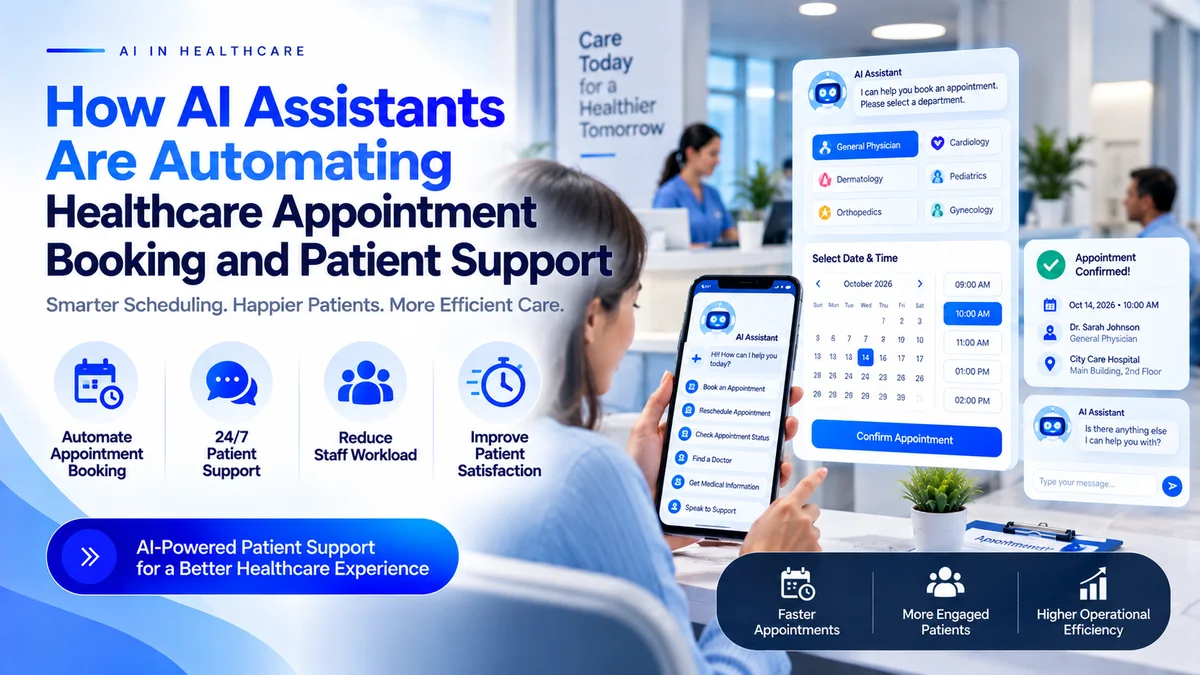
How AI Assistants Are Automating Healthcare Appointment Booking and Patient Support
Healthcare organizations manage thousands of patient interactions every day, from appointment requests and rescheduling to general questions and pre-visit information collection. For hospitals and clinics, handling these tasks manually can place significant pressure on reception teams and healthcare staff. AI-powered healthcare assistants are changing how organizations manage patient communication and appointment booking. Instead of relying entirely on phone calls, emails, or front-desk staff, AI assistants can interact with patients conversationally, collect the required information, help schedule appointments, and provide support throughout the initial patient journey. Solutions such as Virtual Jane are designed to help hospitals and clinics automate routine patient interactions while keeping healthcare professionals involved where human expertise is required.
The Problem : Challenges With Traditional Appointment Booking
Traditional appointment management can become time-consuming for both patients and healthcare teams. Common challenges include:
- High Volume of Appointment Requests : Reception teams may need to manage calls, messages, emails, and walk-in requests simultaneously.
- Long Waiting Times : Patients may have to wait for a staff member to become available before they can schedule or change an appointment.
- Repetitive Administrative Tasks : Staff frequently handle the same questions about doctor availability, appointment timings, departments, and consultation types.
- Missed or Delayed Responses : When staff are busy, patient messages may not receive an immediate response, particularly outside regular working hours.
- Appointment Rescheduling : Changing appointment dates and times manually can create additional administrative work.
AI-powered appointment assistants can help automate many of these repetitive interactions.
How AI-Powered Appointment Booking Works
An AI healthcare assistant can act as a digital front desk for hospitals and clinics. Virtual Jane can interact with patients through conversational interfaces and guide them through the appointment-booking process. A typical workflow can include:
Step 1: Patient Starts a Conversation
The patient interacts with Virtual Jane through an available digital channel and explains what they need. For example: "I want to book an appointment with a cardiologist."
Step 2: Information Collection
The AI assistant can collect relevant details such as:
- Patient name
- Contact information
- Reason for consultation
- Preferred doctor or specialty
- Preferred date and time
- New or existing patient status
Step 3: Appointment Availability
Depending on the organization's system integration, the assistant can help identify available appointment slots based on configured scheduling rules.
Step 4: Appointment Confirmation
Once the patient selects an appropriate slot, the appointment can be confirmed through the configured workflow.
Step 5: Patient Support
The AI assistant can continue supporting the patient with appointment-related questions, reminders, rescheduling requests, and other configured interactions.
This creates a simple patient journey:
- Patient Query
- Information Collection
- Appointment Selection
- Confirmation
- Follow-Up Support
Key Benefits of AI-Powered Appointment Booking
- 24/7 Appointment Access : AI assistants can provide an initial appointment-booking interface outside traditional reception hours, depending on the organization's configuration.
- Reduced Administrative Work : Automating repetitive scheduling conversations can help reception teams spend more time on tasks that require human interaction.
- Faster Patient Response : Patients can receive immediate responses to common appointment-related questions instead of waiting for staff availability.
- Improved Patient Experience : Conversational appointment booking can make the process simpler and more convenient for patients.
- Fewer Repetitive Calls : AI can handle common questions about departments, specialties, appointment availability, and scheduling workflows.
- Multilingual Patient Communication : Where configured, AI assistants can support multiple languages, helping healthcare organizations communicate with diverse patient populations.
- Better Workflow Integration : AI appointment assistants can be connected with scheduling platforms, CRM systems, EHR/EMR systems, and other healthcare technologies depending on the organization's technical environment.
Beyond Appointment Booking: AI-Powered Patient Support
An AI healthcare assistant can do more than schedule appointments. Patients often need assistance before and after booking. An AI assistant can support different stages of the patient journey.
- Pre-Visit Support : Before an appointment, the assistant can help collect basic patient information and provide configured instructions about the visit.
- Patient Navigation : Patients can ask questions about departments, specialties, consultation types, or available services.
- Appointment Rescheduling : Patients can request changes to their appointments through a conversational interface, subject to the organization's scheduling rules.
- Follow-Up Support : After an appointment, AI can support configured follow-up interactions and help patients connect with the appropriate healthcare team.
- Frequently Asked Questions : AI assistants can provide responses to common administrative questions, reducing the need for staff to answer repetitive queries manually.
Virtual Jane: AI-Powered Healthcare Assistant
Virtual Jane is an AI-powered healthcare assistant designed to support patient communication, appointment booking, patient intake, and triage workflows. It provides a conversational interface that allows patients to interact with healthcare organizations more easily. Virtual Jane can help organizations:
- Automate appointment booking conversations
- Collect patient information
- Support patient intake
- Assist with appointment scheduling
- Support appointment-related queries
- Provide multilingual communication
- Support predefined triage workflows
- Connect patients with appropriate healthcare pathways
- Reduce repetitive administrative tasks
By automating routine interactions, Virtual Jane can act as a digital support layer for healthcare teams while allowing doctors, nurses, and administrative staff to focus on tasks that require human expertise.
Real-World Use Cases
AI-powered appointment booking and patient support can be used across different healthcare environments.
- Hospitals : Hospitals can use AI assistants to handle appointment requests, patient inquiries, and navigation across departments.
- Clinics : Clinics can automate appointment scheduling and reduce the workload associated with repetitive patient communication.
- Specialist Practices : Patients can interact with an AI assistant to find the appropriate specialty and schedule consultations according to configured workflows.
- Telehealth : AI can support patients before a virtual consultation by collecting information and assisting with scheduling.
- Diagnostic Centers : AI assistants can help patients with appointment requests, service-related questions, and scheduling workflows.
- Follow-Up Care : Healthcare organizations can use AI to support post-appointment communication and follow-up workflows.
The Future of AI-Powered Healthcare Assistants
The role of AI in healthcare is moving beyond simple chatbots. Modern AI assistants can become connected with appointment systems, EHRs, EMRs, Hospital Information Systems, telehealth platforms, CRM systems, and patient portals. This can create a more connected digital patient journey where patients can interact with a healthcare organization from their first inquiry through appointment booking and follow-up support. However, AI should complement healthcare professionals rather than replace them. Appropriate human oversight, privacy controls, security measures, escalation pathways, and organizational policies remain essential.
Conclusion
AI-powered appointment booking is helping hospitals and clinics modernize the way they interact with patients. From scheduling appointments and answering routine questions to supporting patient intake and navigation, AI assistants can reduce repetitive administrative work and provide patients with a more convenient digital experience. Virtual Jane brings these capabilities together through an AI-powered healthcare assistant designed for appointment booking, patient support, intake, and triage workflows. For healthcare organizations looking to improve patient engagement while streamlining administrative processes, AI-powered assistants can provide a practical foundation for building smarter and more connected healthcare workflows.
