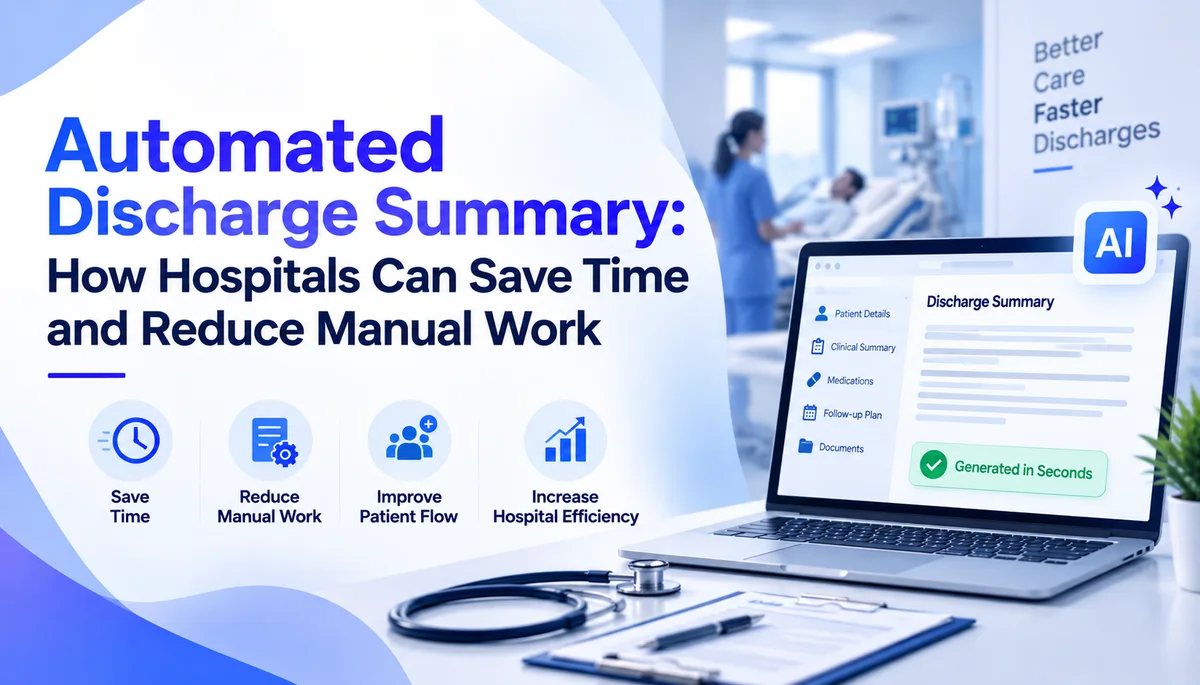
Automated Discharge Summary : How Hospitals Can Save Time and Reduce Manual Work
Discharge is one of the final steps in a patient's hospital journey, but it can also become a time-consuming process for doctors and hospital staff. Preparing the discharge summary requires reviewing patient information, treatment details, test results, medicines, and follow-up instructions before the patient can complete the discharge process. When this work is handled completely manually, even a small delay can affect the hospital's daily workflow.
This is where automated discharge summary can make a practical difference.
Instead of preparing every discharge summary from the beginning, hospitals can use automation to organize patient information and create a draft that can be checked and approved by the doctor.
What Is Automated Discharge Summary?
Automated discharge summary is a digital solution that helps healthcare teams prepare patient discharge summaries with less manual effort.
- Patient and admission details
- Diagnosis
- Treatment and procedures
- Investigations and test results
- Medicines
- Patient condition at discharge
- Follow-up instructions
- Doctor's recommendations
The healthcare professional can review the information, make changes where required, and approve the final summary. So, the purpose is not to replace the doctor. It is to reduce repetitive documentation work.
Why Manual Discharge Documentation Can Be a Problem
In a busy hospital, doctors may handle several patients at the same time. Preparing discharge documentation adds another administrative responsibility to an already demanding workflow. Information may need to be checked across different records before the final document is prepared. This can lead to:
- Extra documentation time
- Repeated data entry
- Delays in completing discharge paperwork
- Inconsistent document formats
- Additional administrative workload
These small delays can become more important when a hospital handles a large number of discharges every day.
The Real Benefit : Helping Patients Leave Earlier
Saving documentation time is useful, but hospitals should look at the bigger picture. If a patient is medically ready for discharge, completing the required documentation efficiently can help avoid unnecessary administrative delays. The connection is simple:
- Less manual documentation
- Faster summary preparation
- Smoother discharge process
- Bed available sooner
Earlier Bed Availability Can Improve Hospital Operations
A hospital bed is a limited resource. When a patient completes their treatment and discharge process, that bed can be prepared for the next patient. If documentation takes longer than necessary, the bed may remain occupied during that period. By improving the discharge workflow, hospitals can work toward making beds available sooner. This can support better:
- Bed utilization
- Patient movement
- Admission planning
- Discharge coordination
- Hospital resource utilization
For hospitals operating at high occupancy, even improvements in workflow can be valuable.
Can Automation Increase Hospital Capacity?
Hospital capacity is not only about adding more beds. The way existing beds are used also matters. For example, if a hospital has 100 beds, improving the speed of patient turnover may allow those existing beds to support more patients over time.
This does not mean every hospital will automatically increase its patient volume after implementing. Results depend on factors such as demand, staffing, occupancy, length of stay, and clinical workflow. However, reducing avoidable administrative delays can help hospitals make better use of the capacity they already have.
Where Does ROI Come From?
For hospital management, the important,
Why should we invest in discharge automation? The answer should be measured through actual operational improvements. Potential areas of value include:
Less Staff Time
When preparing an initial discharge summary, doctors and staff do not have to start every document from a blank page.
Faster Workflow
A quicker documentation process can help reduce administrative delays after the clinical team has decided that the patient is ready for discharge.
Better Bed Utilization
When beds become available sooner, hospitals can potentially use their existing bed capacity more efficiently.
More Patients Served
Better bed turnover may allow a hospital to manage additional patients over time when there is sufficient demand and the workflow can support it.
Lower Administrative Burden
Reducing repetitive documentation can allow healthcare staff to spend more time on activities that require their attention and expertise.
A Simple Way to Measure the Business Impact
Hospitals can compare their discharge process before and after automation.
For example, they can track :
- Average time spent preparing one discharge summary
- Number of discharge summaries prepared each month
- Average time from discharge decision to completed documentation
- Time taken to make the bed available after discharge
- Bed utilization and patient throughput
These numbers can provide a clearer picture of whether the technology is creating measurable value. The ROI will be different for every hospital because it depends on patient volume, staffing costs, bed occupancy, costs, and existing processes.
What Makes AI-Based Automation Different?
Traditional digital templates still require healthcare professionals to enter most information manually. AI-based solutions can go a step further by helping organize information and prepare a first draft based on available patient data. This can make the documentation process more convenient, particularly for hospitals handling a large number of patient records. However, AI-generated content should not be treated as automatically correct. The final summary should always be reviewed by the appropriate healthcare professional.
How DischargeNova Supports the Process
DischargeNova is designed to help hospitals simplify the preparation of discharge summaries using AI. Instead of spending time creating the complete document manually, healthcare professionals can work with an AI-generated draft, review the information, make necessary corrections, and finalize the summary. The aim is to make the discharge documentation process more efficient while keeping clinical responsibility with healthcare professionals.
For hospitals, the larger objective is:
- Reduce manual work.
- Improve discharge efficiency
- Make beds available sooner
- Use existing capacity more effectively
The Business Case for Hospitals
Discharge automation should not be viewed only as a documentation tool. It can be part of a broader hospital efficiency strategy. When a hospital improves the way discharge documentation is handled, it can potentially create benefits across the workflow:

This is why hospitals should evaluate discharge automation not only by asking how many minutes are saved on documentation, but also by looking at what those saved minutes mean for the wider hospital operation.
Conclusion
Automated discharge summary can help hospitals reduce repetitive documentation and make the discharge process more organized.
The biggest opportunity is not simply creating a discharge summary faster. It is about what happens afterward.
When documentation-related delays are reduced, eligible patients may be able to complete their discharge process sooner. This can help make beds available earlier, improve bed utilization, support patient flow, and potentially allow hospitals to make better use of their existing capacity.
For hospitals, that can turn documentation automation into a broader operational improvement with the potential for measurable time savings, capacity benefits, and ROI. DischargeNova helps bring this approach into the hospital workflow by using AI to assist with discharge summary preparation while keeping healthcare professionals in control of the final document.
