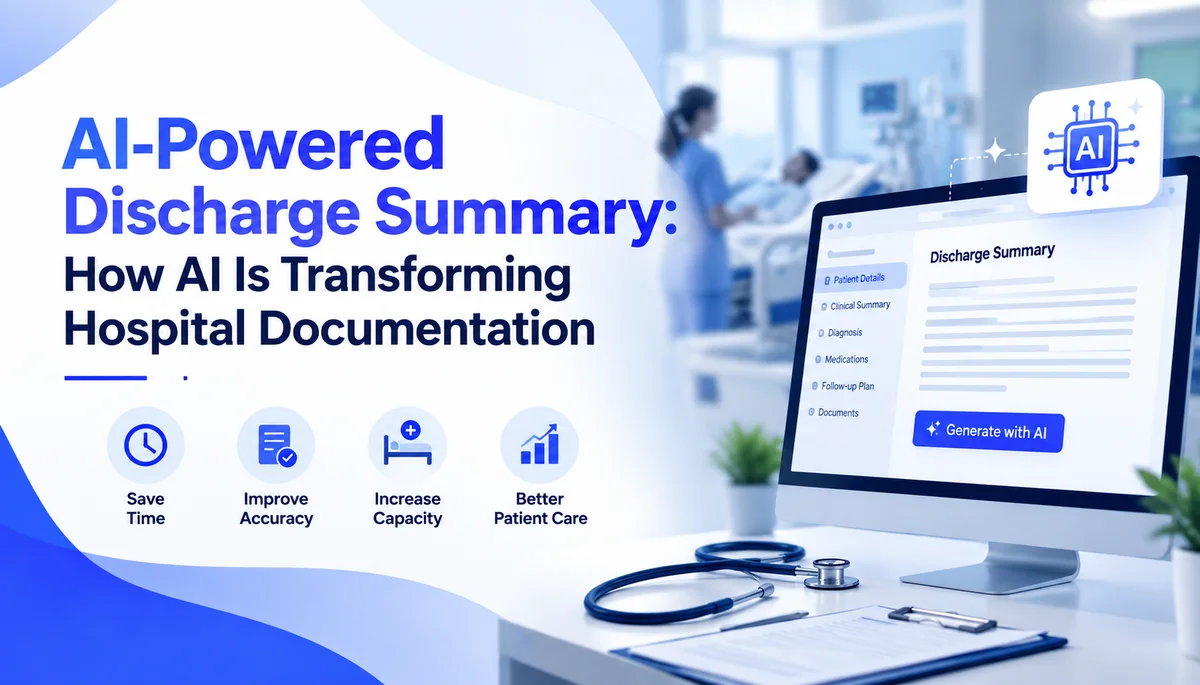
AI-Powered Discharge Summary: How AI Is Transforming Hospital Documentation
Hospital discharge is an important part of patient care, but preparing a discharge summary can take significant time. Doctors and hospital staff often need to collect information from different medical records, review treatment details, document medications, and prepare follow-up instructions.
An AI-powered discharge summary can help hospitals automate parts of this process, reduce manual documentation, and make the discharge workflow more efficient. But the biggest benefit is not simply saving documentation time.
When documentation is completed faster, eligible patients can complete the discharge process earlier, beds can become available sooner, and hospitals can potentially serve more patients using their existing capacity.
What Is an AI-Powered Discharge Summary?
An AI-powered discharge summary uses artificial intelligence to organize relevant patient information and create a structured discharge summary.
Depending on the hospital's workflow and available data, the system helps extract, consolidate, and structure:
The Problem With Manual Discharge Documentation
Traditional discharge documentation can require doctors and hospital staff to collect information from multiple records and manually prepare the final summary.
This can create delays, especially in hospitals with a high number of daily discharges.
A patient may be clinically ready to leave, but the discharge process can still require documentation, review, approvals, medication information, and other administrative steps.
When these processes take longer, the hospital bed may remain occupied for longer.
This is where discharge automation can create an operational advantage.
How AI Can Help Hospitals Discharge Patients Earlier
The main objective of discharge automation is not simply to generate a document. It is to help make the overall discharge workflow faster and more efficient. The workflow can be:
- Patient Information
- AI-Assisted Summary
- Clinical Review
- Final Discharge Summary
- Patient Discharge
By reducing repetitive documentation work, healthcare professionals can spend less time preparing the initial summary and more time reviewing important clinical information.
When all other discharge requirements are completed, faster documentation can support an earlier discharge process.
HIMS Integration : Connecting Discharge Automation With Hospital Systems
One of the important capabilities of modern discharge automation is HIMS integration. Hospitals already store patient information in Hospital Information Management Systems (HIMS) or other hospital software. If discharge documentation requires staff to manually copy information from the HIMS into another system, some of the efficiency benefits of automation can be lost. With HIMS integration, DischargeNova can be designed to work as part of the hospital's existing digital workflow. Depending on the hospital's system and integration architecture, relevant information can be transferred from the HIMS into the discharge workflow, such as:
- Patient demographics
- Admission and discharge details
- Diagnosis
- Treatment information
- Procedures
- Investigation results
- Medication information
- Doctor's notes
- Other relevant clinical information
Why HIMS Integration Matters
- HIMS
- Patient Data
- DischargeNova AI
- Clinical Review
- Final Discharge Summary
- Patient Discharge
Earlier Patient Discharge Means Earlier Bed Availability
This is one of the most important benefits for hospitals. Consider a hospital with limited beds. If a patient is ready for discharge but the documentation process takes several additional hours, the bed remains occupied during that period. With a more efficient discharge workflow:
- Faster documentation
- Earlier completion of discharge process
- Patient leaves earlier when clinically appropriate
- Bed becomes available earlier
- Next patient can use the bed
This can improve bed utilization and patient flow. AI does not determine when a patient should leave the hospital. The clinical team makes that decision. AI can help reduce documentation-related delays around that decision.
Increase Hospital Capacity Without Adding More Beds
Hospital capacity is not only about the number of physical beds. It is also about how efficiently those beds are used. If beds are occupied longer than necessary because of avoidable administrative delays, the hospital may not be able to use its existing capacity efficiently. For example, improving the discharge workflow can help hospitals increase patient turnover through existing beds. This can potentially allow a hospital to:
- Serve more patients
- Improve bed utilization
- Reduce avoidable discharge delays
- Improve patient flow
- Use existing infrastructure more efficiently
Therefore, discharge automation can contribute to increased effective hospital capacity.
How Discharge Automation Can Improve Hospital ROI
The financial value of AI discharge automation comes from more than reducing documentation hours. Hospitals can evaluate ROI across several areas.
Staff Time Savings
If doctors and staff spend less time preparing repetitive documentation, that time can be redirected toward clinical and operational activities.
Better Bed Utilization
Earlier availability of beds can help hospitals use their existing infrastructure more effectively.
Higher Patient Throughput
When beds become available sooner, hospitals may be able to accommodate additional patients over time, depending on demand and other operational constraints.
Reduced Administrative Work
Automation can reduce repetitive manual tasks associated with creating and formatting discharge summaries.
Better Use of Existing Infrastructure
Hospitals may improve the utilization of existing beds and resources without immediately needing additional physical infrastructure.
Better Integration With Existing HIMS
By connecting discharge automation with the hospital's existing HIMS, hospitals can reduce duplicate data entry and create a more connected documentation workflow.
AI Discharge Summary vs Manual Documentation
| Manual Process | AI-Assisted Process |
|---|---|
| Information collected manually | Information can be organized automatically |
| Repetitive documentation | Reduced repetitive work |
| More time spent preparing drafts | AI can generate a draft |
| Different documentation formats | Standardized templates can be used |
| Manual transfer between systems | HIMS integration can reduce duplicate data entry |
| Potential administrative delays | Faster documentation workflow |
| Limited visibility into time savings | Workflow efficiency can be measured |
AI does not replace the doctor. Instead, it can act as a documentation assistant while the healthcare professional remains responsible for reviewing and approving the final summary.
Improving Patient Flow
Efficient discharge is closely connected to patient flow. A hospital needs to continuously manage:
If discharge is delayed, the entire flow can be affected. By making documentation more efficient and connecting the discharge process with existing HIMS systems, hospitals can work toward smoother movement of patients through different stages of care. This can be particularly valuable for hospitals with high patient volumes and high bed occupancy.
Why Hospitals Should Consider Discharge Automation
Hospitals investing in AI should look beyond individual tasks. The important question is :
How can AI improve the overall hospital workflow and create measurable operational value?
For discharge documentation, the potential value can be represented as:
- HIMS Integration
- AI-Assisted Documentation
- Less Manual Work
- Faster Documentation
- Earlier Completion of Discharge Process
- Earlier Bed Availability
- Improved Bed Utilization
- Increased Effective Capacity
- Potentially Better Hospital ROI
This makes discharge automation an operational improvement opportunity, not just a documentation tool.
Conclusion
The real value of an AI-powered discharge summary goes beyond creating a document faster.
For hospitals, efficient discharge documentation can support a larger operational chain:
- HIMS Integration
- AI-Assisted Documentation
- Faster Discharge Documentation
- Earlier Discharge When Clinically Appropriate
- Earlier Bed Availability
- Better Bed Utilization
- Increased Effective Capacity
- Improved Operational Efficiency
- Potential ROI
AI should not replace clinical judgment. Instead, it can reduce repetitive documentation work and help healthcare professionals complete discharge processes more efficiently. With solutions such as DischargeNova, hospitals can move from manual discharge documentation toward a more structured, efficient, and AI-assisted workflow that can work alongside their existing HIMS and hospital technology infrastructure.
