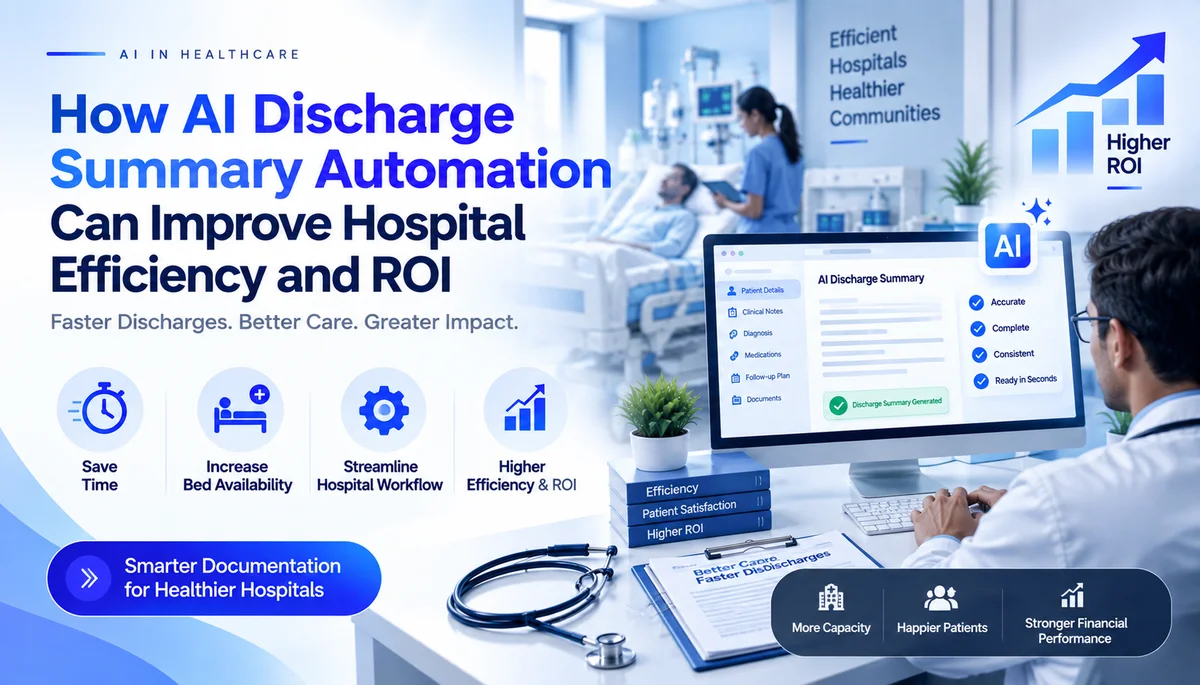
How AI Discharge Summary Automation Can Improve Hospital Efficiency and ROI
Hospitals are under constant pressure to improve patient care while managing staff time, operational costs, and limited resources. As patient volumes increase, even routine administrative tasks can have a noticeable effect on the overall workflow. Discharge documentation is one such task. Preparing a discharge summary requires time from doctors and clinical staff. When the process is repeated hundreds or thousands of times each month, the accumulated effort can become significant. Discharge automation offers hospitals a way to reduce some of this repetitive work while creating a more efficient path from treatment completion to patient discharge. The potential value is not limited to documentation. For hospital management, the bigger question is how automation can contribute to hospital efficiency, capacity utilization, and ROI.
Where Does the Hospital Lose Time?
A hospital's daily workflow contains many connected activities. A patient is admitted, receives treatment, undergoes investigations, and eventually reaches the point where the clinical team decides that discharge is appropriate. At that stage, documentation still needs to be completed. If preparing the discharge summary requires considerable manual effort, it can add another delay to the process. One delayed discharge may seem insignificant. But when the same delay occurs across many patients, the accumulated effect can become much larger. This is where AI healthcare solutions can help address repetitive administrative work.
How Discharge Automation Changes the Workflow
With a manual process, the doctor may need to collect information, write the summary, format it, and review the completed document. An AI-assisted process can provide a different starting point. The system can help organize available patient information and prepare a draft. The doctor then reviews the content, makes the required changes, and approves the final summary.
The workflow becomes :
- Patient Information
- AI Assistance
- Draft
- Clinical Review
- Final Discharge
The purpose is not to remove the doctor from the process. It is to reduce the amount of repetitive work that the doctor has to perform.
Hospital Efficiency Starts With Small Improvements
Hospital efficiency is built from many individual connected processes:
- Admission
- Registration
- Clinical Documentation
- Investigations
- Billing
- Discharge
- Bed Turnover
If one process becomes more efficient, it can make the next process easier to manage. Discharge is particularly important because it connects one patient's hospital stay with the availability of resources for the next patient. Improving this part of the workflow can therefore have an effect beyond the discharge department itself.
Better Use of Doctors' Time
Doctors spend time on clinical decision-making, patient communication, documentation, and administrative responsibilities. Not every documentation activity requires the same level of clinical input. Preparing repetitive sections of a discharge summary is one area where automation can provide assistance. Instead of spending as much time creating the initial document, the doctor can focus on checking the information and adding clinical details where necessary. This can make professional time more productive.
The Connection Between Discharge Automation and Bed Utilization
This is one of the most important operational considerations. A hospital bed has a fixed physical capacity. When a patient has completed treatment and the discharge process is finished, the bed can eventually be prepared for another patient. If documentation is one of the factors causing a delay, improving that process may help release the bed sooner. The operational chain can be represented as:
- Discharge Automation
- Less Documentation Work
- More Efficient Processing
- Earlier Bed Release
- Improved Bed Utilization
The technology itself does not increase the number of physical beds. Instead, it can help hospitals make better use of the capacity they already have.
Can Better Bed Utilization Improve ROI?
Potentially, yes. Hospitals have substantial investments in:
- Beds
- Buildings
- Medical equipment
- Clinical staff
- Nursing teams
- Support services
- IT infrastructure
When existing capacity is not fully utilized because of workflow delays, the hospital may not be getting the maximum operational value from those investments. Improving discharge efficiency can contribute to better utilization. If demand exists and other resources are available, earlier bed availability may allow another patient to be admitted sooner. This creates a potential link between discharge automation and hospital ROI. However, the financial impact will vary by hospital and should be measured using actual operational data.
Measuring the Financial Impact
Hospitals should avoid judging an AI solution only by the number of documents generated. A better approach is to measure the complete workflow across these core metrics:
Documentation Time
How long does it take to prepare a discharge summary before and after automation?
Staff Time
How many hours do doctors or staff spend on discharge documentation each month?
Discharge Turnaround
How much time passes between the clinical discharge decision and completion of the discharge process?
Bed Turnaround
How quickly does a discharged bed become available for the next patient?
Patient Throughput
Has the hospital been able to manage patient movement more efficiently?
Cost & ROI
What is the current cost of the manual process compared with the cost of implementing and operating the AI solution?
These measurements provide a more realistic view of overall hospital ROI.
A Simple Hospital ROI Framework
Hospitals can think about the business case using three core areas:
Direct Savings
Reduced staff time spent on repetitive documentation and lower administrative workload.
Operational Gains
Improved bed utilization, smoother patient flow, and reduced discharge-related delays.
Capacity Value
Accommodating additional patients when demand exists to evaluate the additional operational value created.
The combined benefit can then be compared with:
- Software cost
- Implementation cost
- Integration cost
- Training and support cost
This provides a more complete picture of the investment.
Why Automation Becomes More Valuable at Scale
Consider a hospital that completes only a small number of discharges each month. The time saved may be relatively modest. Now consider a large hospital handling hundreds or thousands of discharges. A small improvement repeated across every discharge can create a much larger cumulative effect. This is why the value of discharge automation can increase as discharge volume grows. The technology is not necessarily about saving a huge amount of time on one document. It is about eliminating repetitive work across the entire operation.
Improving Patient Flow
Hospital efficiency is closely connected to patient flow. When one patient completes treatment and leaves efficiently, the hospital can begin preparing the bed for the next patient. Better coordination between discharge, housekeeping, bed management, and admissions can create a smoother cycle. AI-powered documentation can support one part of that cycle. It should therefore be viewed as a component of a wider hospital efficiency strategy, rather than a standalone documentation feature.
Why Human Review Still Matters
Healthcare documentation cannot be treated like ordinary business paperwork. A discharge summary contains clinically important information. AI can assist with organizing and drafting content, but healthcare professionals should review the information before the summary becomes part of the final patient record. A practical approach is:
- AI Assists Preparation
- Clinician Verifies Content
- Professional Approves Summary
This keeps clinical responsibility where it belongs while allowing hospitals to benefit from automation.
How DischargeNova Supports Hospital Efficiency
DischargeNova is an AI-powered discharge summary solution designed to help hospitals reduce repetitive documentation work. The system assists with preparing structured discharge summaries so healthcare professionals can review and finalize them more efficiently. For hospitals,
the potential value extends beyond the document itself. DischargeNova can support the broader objective of:
- Reducing documentation workload
- Improving discharge workflow
- Supporting faster completion of discharge documentation
- Helping make beds available sooner when clinically appropriate
- Improving utilization of existing hospital capacity
- Supporting more efficient patient flow
- Creating measurable operational data for ROI analysis
What Hospital Leaders Should Ask
Before investing in any AI healthcare solution, hospital management should ask practical questions. How much time are we currently spending on discharge documentation? Where are the biggest delays in our discharge process? How much does an occupied bed cost us operationally? How quickly can a discharged bed be made available? Can we measure the improvement after automation? Will the solution work with our existing hospital systems? These questions help shift the discussion from technology features to measurable business outcomes.
From Documentation Cost to Capacity Opportunity
The most interesting aspect of discharge automation is that it can change how hospitals think about documentation. Traditionally, documentation is viewed as an administrative cost. With automation, it can also become an opportunity to improve workflow efficiency.
The potential chain is:
- Reduce repetitive documentation
- Save staff time
- Complete discharge more efficiently
- Release beds sooner
- Improve bed utilization
- Support patient throughput
- Better use of infrastructure
- Improve hospital ROI
The exact result will depend on each hospital's operating model, patient volume, staffing, occupancy, and demand.
Conclusion
AI discharge summary automation can help hospitals address one of the most repetitive parts of the patient journey. Its value should not be measured only by how quickly a document is created. The larger opportunity is to improve the workflow surrounding discharge. When documentation becomes more efficient, hospitals can potentially reduce staff workload, support faster discharge processing, improve bed availability, and make better use of their existing capacity. For hospital management, these improvements can translate into measurable operational benefits and potentially stronger ROI. DischargeNova brings AI into the discharge documentation process to help hospitals move toward a more efficient, scalable, and digitally connected workflow—while keeping clinical review and decision-making with healthcare professionals.
