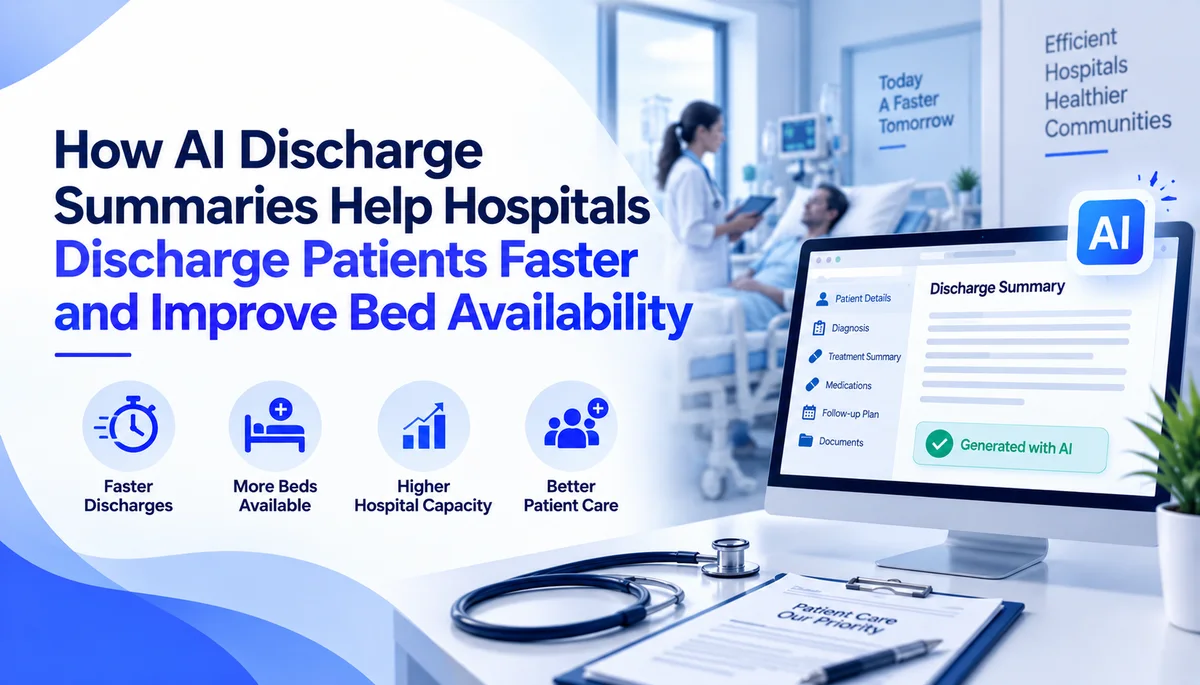
How AI Discharge Summaries Help Hospitals Discharge Patients Faster and Improve Bed Availability
For hospitals, bed availability can have a direct impact on how smoothly patients move through the facility. A bed occupied by a patient who has already completed treatment cannot immediately be used for someone waiting for admission. This is one reason the discharge process matters so much. Clinical decisions will always determine when a patient is ready to leave. However, once that decision has been made, administrative work such as preparing the discharge summary can still take time. This is where AI discharge management can support hospitals. By helping healthcare teams prepare discharge documentation more efficiently, AI can contribute to a smoother process from the doctor's discharge decision to the release of the hospital bed.
Why Faster Discharge Matters to Hospitals
When a patient is ready to leave, several activities may need to be completed before the bed can be released. These can include:
- Preparing the discharge summary
- Reviewing medicines
- Completing clinical documentation
- Providing patient instructions
- Obtaining required approvals
- Coordinating with billing and other departments
Not every delay comes from documentation. However, documentation is one part of the process that can be improved through automation. A more efficient discharge workflow can help reduce unnecessary waiting after the clinical decision has already been made.
The Connection Between Discharge and Bed Availability
The relationship is easy to understand. Imagine a hospital has 100 beds and most of them are occupied. If several patients are ready for discharge but their discharge process takes longer than necessary, those beds remain unavailable to incoming patients. Once the patients complete the discharge process, the beds can be cleaned, prepared, and assigned to new patients. This makes hospital bed availability closely connected to the efficiency of patient movement. The objective is not to discharge patients prematurely. It is to make the process more efficient after the clinical team has determined that discharge is appropriate.
Where AI Fits Into the Process
An AI discharge solution can assist with preparing the patient's discharge summary using relevant information already available in the hospital's records. Instead of spending time assembling the document manually, a doctor can start with an AI-assisted draft.
The workflow can look like:
- Patient data
- AI-assisted summary
- Doctor review
- Final approval
- Discharge
Faster Patient Discharge Does Not Mean Rushing Patients
There is an important distinction between faster discharge and premature discharge. AI should not decide whether a patient is medically ready to leave. The treating team makes that decision based on the patient's condition and the hospital's clinical protocols. The role of AI is different. It can help reduce the amount of time spent on repetitive documentation once the patient is ready for discharge. So the goal is:
Not faster clinical decisions, but faster completion of necessary administrative work.
From One Patient to the Entire Hospital
The impact of a small improvement can become more meaningful when repeated across hundreds or thousands of discharges. For example, if a hospital handles a large number of discharges every month, even a modest reduction in documentation time can add up to substantial staff time savings. More importantly, if documentation is one of the reasons a bed cannot be released, improving that step may contribute to faster bed turnover. This can help hospitals manage patient movement more effectively.
Better Bed Turnaround
Bed turnaround involves more than simply having an empty bed. After one patient leaves, the hospital may need to complete cleaning, prepare the room, update the bed status, and coordinate the next admission. If the discharge process itself is delayed, all of these activities start later. Reducing avoidable discharge delays can therefore give downstream teams more time to prepare the bed. This can contribute to a more predictable admission and discharge cycle.
Supporting Emergency and Planned Admissions
Bed availability becomes particularly important when new patients are waiting for admission. For planned admissions, better visibility of expected bed availability can make scheduling easier. For emergency departments, available inpatient beds can affect how quickly suitable patients can move to the next stage of care. AI cannot create additional physical beds, but better discharge workflow can help hospitals make more effective use of the beds they already have.
How Hospitals Can Benefit
AI-assisted discharge workflows may support hospitals in several areas:
Reduced Documentation Time
Doctors can work from an AI-generated draft instead of creating every section manually.
Earlier Completion of Discharge
When documentation is prepared efficiently, the administrative portion of discharge can be completed sooner.
Improved Bed Availability
Once the patient has completed the required discharge process, the bed can move toward being available for another patient.
Better Patient Flow
Faster movement through discharge can help reduce bottlenecks between admissions, treatment, and bed allocation.
More Effective Capacity Utilization
Hospitals may be able to use their existing beds more efficiently rather than relying only on additional infrastructure to increase capacity.
The ROI Opportunity
For hospital management, faster discharge has an important operational question behind it:
What is the value of making an existing bed available sooner?
The answer will differ from one hospital to another.
A hospital can examine:
- Number of beds
- Occupancy rate
- Monthly discharges
- Average discharge processing time
- Time between discharge decision and bed release
- Number of patients waiting for admission
- Average revenue or cost associated with a bed day
- Documentation staff costs
These figures can help the hospital estimate the financial impact of improving the discharge process.
The potential value comes from a combination of staff time saved and more effective use of hospital capacity.
A Practical Example
Consider a hospital with consistently high occupancy. During a busy day, several patients are medically ready to leave. If their discharge documentation takes longer than expected, their beds remain occupied. Now imagine the documentation process is supported by AI. The doctor receives an organized draft, reviews the clinical information, makes corrections where needed, and completes the summary. If this removes part of the administrative delay, the discharge process can move forward sooner. Once the patient leaves and the bed is prepared, another patient may be admitted. Repeated across many discharges, improvements like this can contribute to better utilization of the hospital's existing resources.
The actual impact will depend on the hospital's workflow and other factors affecting discharge and admission.
How DischargeNova Supports AI Discharge Management
DischargeNova is designed to help hospitals use AI for discharge summary preparation. The platform assists with organizing patient information and creating a structured discharge summary for healthcare professionals to review. The focus is not simply on producing a document. It is on supporting a more efficient discharge workflow that can help hospitals work toward:
What Hospitals Should Measure
To understand whether AI discharge management is making a difference, hospitals should track actual workflow data. Useful metrics include:
- Average discharge documentation time
- Time from discharge decision to patient departure
- Bed turnaround time
- Daily number of completed discharges
- Bed occupancy
- Number of patients waiting for beds
- Staff time spent on discharge documentation
- Patient throughput
These measurements can show whether an AI solution is delivering operational improvements rather than simply adding another system.
Conclusion
Faster patient discharge is not about rushing patients through the hospital. It is about removing unnecessary delays once the clinical team has determined that a patient is ready to leave. AI can support this process by reducing repetitive documentation work and helping healthcare professionals prepare discharge summaries more efficiently. The potential impact reaches beyond the document itself. Efficient discharge documentation can support earlier patient departure, earlier bed availability, improved patient flow, and better use of existing hospital capacity. For hospitals operating under pressure from high occupancy and growing patient demand, AI discharge management can therefore become part of a broader strategy for improving operational efficiency and making better use of existing resources. DischargeNova helps hospitals bring AI into this part of the patient journey while keeping clinical review and decision-making with healthcare professionals.
